White House Revises Initial Claims About Alex Pretti Following Intense Backlash | Trump Administration

White House Struggles to Navigate Backlash Over Minnesota Shooting Incident
White House officials have moved swiftly to distance President Donald Trump and senior officials from their early characterization of the man fatally shot by federal agents in Minnesota as a gunman. This response comes amid intensifying backlash after footage emerged that seemingly contradicts their claims.
The shift in narrative arose as advisers recognized that the derogatory portrayals of Alex Pretti, who was reportedly licensed to carry a firearm, had turned the incident into a significant political liability for the president.
During the weekend, prominent administration figures, including Deputy Chief of Staff Stephen Miller, referred to Pretti as “a domestic terrorist who tried to assassinate law enforcement.” Homeland Security Secretary Kristi Noem further escalated the rhetoric, accusing Pretti of embodying “the definition of domestic terrorism.”
These assertions were undermined by video evidence showing Pretti being shot in the back approximately ten times after being restrained by U.S. Border Patrol agents whom he had been filming, and subsequently disarmed.
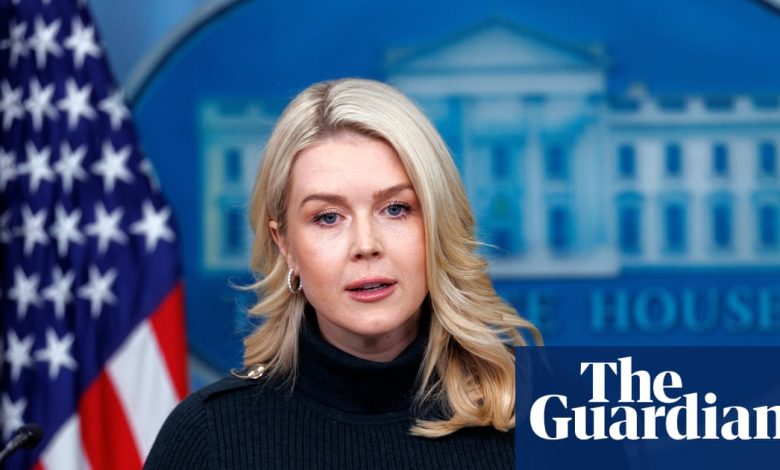
At a Monday briefing, White House Press Secretary Karoline Leavitt avoided addressing the remarks made about Pretti, emphasizing that the administration would refrain from commenting until investigations into the shooting had concluded. “I have not heard the president characterize Mr. Pretti in that way,” she stated, adding that Trump preferred to let the facts dictate the investigation’s direction.
Deputy Attorney General Todd Blanche attempted to clarify the administration’s position, stating, “I don’t think anybody thinks that they were comparing what happened on Saturday to the legal definition of domestic terrorism.”
The rapid evolution of the White House’s stance reflects its sensitivity to a declining support for Immigration and Customs Enforcement (ICE) and border patrol tactics, particularly among Republican officials in Washington.
Trump also appeared to be pivoting from his earlier position, having blamed Minnesota Governor Tim Walz and Democrats for Pretti’s death in prior statements. In a new announcement, he revealed that he had a “very good call” with Walz and they were aligned on moving forward with immigration enforcement in the state.
Walz’s office confirmed that Trump agreed to consider withdrawing federal agents from Minnesota and to ensure state investigators could conduct independent inquiries rather than solely relying on internal investigations by the Department of Homeland Security.
“The president agreed that he would discuss with his Department of Homeland Security to allow the Minnesota Bureau of Criminal Apprehension (BCA) to conduct an independent investigation, as is standard practice,” the statement read.
Furthermore, Trump committed to evaluating the reduction of federal agents in Minnesota while fostering a more coordinated approach with the state concerning immigration enforcement related to violent offenders.
Walz’s call for a state investigation follows the BCA’s complaints over the weekend regarding their inability to access the shooting scene due to federal obstruction, despite obtaining a court order.
Additionally, Trump has announced the appointment of Tom Homan, his “border czar,” to oversee the situation in Minneapolis, replacing U.S. Border Patrol Chief Gregory Bovino. This change signals a potential repudiation of Noem, Bovino’s superior, amidst ongoing tensions between the two.
Despite these internal shifts, Leavitt maintained a narrative of blame directed at Walz and Democrats during her briefing. “This tragedy occurred due to ongoing hostility from Democrat leaders,” she asserted.
Notably, administration officials privately expressed that they view the shooting as an unfortunate accident attributable to agents reacting to perceived danger. This highlights the dangers of hastily blaming the victim and defending agents prior to a thorough investigation.
The White House’s initial response to Pretti’s shooting echoed previous handling of another recent incident involving a Minneapolis resident, Renee Nicole Good, a 37-year-old protester shot in her vehicle. After initially doubling down on claims that Good attempted to run over an agent, Trump later expressed regret upon learning of her father’s support for his administration, stating, “You know, when the woman was shot, I felt terribly about it.”