
“Ladies and gentlemen, we got him!” Paul Bremer, the US proconsul in Iraq, famously declared at a press conference in Baghdad on 14 December 2003, a day after US troops had captured Saddam Hussein. Iraqis in the audience broke out in cheers, leapt up from their seats and pumped their fists in the air – many had waited decades for that moment. “This is a great day in Iraq’s history,” Bremer said, adding: “The tyrant is a prisoner.”
I was in the audience that day in Baghdad, covering the Iraq invasion’s aftermath as a correspondent for a US newspaper. It quickly became clear that Bremer and other jubilant US officials would use the occasion – US soldiers dragged the disheveled former Iraqi dictator out of a hole in the ground where he had been hiding near his home town – to declare that America’s war had reached a decisive turn. Despite a growing insurgency led by ex-members of the Iraqi security forces, US officials in Baghdad and Washington projected confidence that victory was in sight now that Saddam was locked up and headed for the gallows.
That turned out to be wishful thinking, as the Iraq war and insurgency dragged on for years. Saddam’s capture was ultimately a minor blip – and the first in a series of “we got him” episodes, where US officials would celebrate the arrest or killing of an insurgent or jihadist leader as a turning point, only to be further embroiled in a grinding conflict that destroyed Iraqi society and cost America enormous blood and treasure.
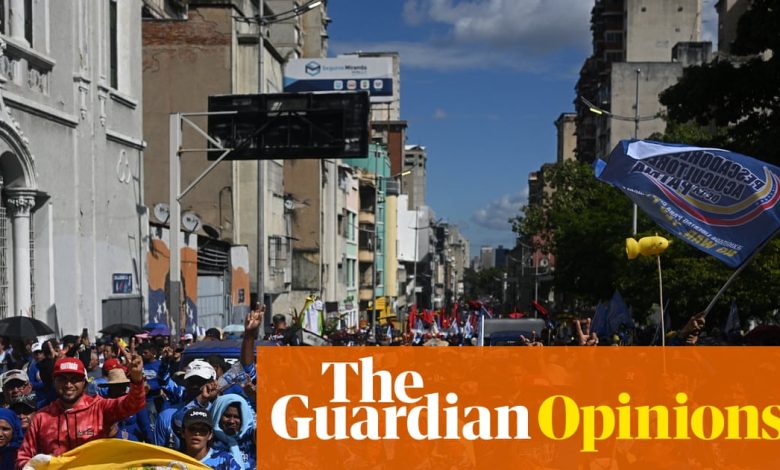
I thought of Bremer’s gleeful declaration as I watched Donald Trump announce on 3 January that US forces had attacked Venezuela and seized its president, Nicolás Maduro, whisking him to New York to stand trial on drugs, weapons and “narco-terrorism” charges. Trump didn’t have a pithy quote lined up as Bremer had done, but the president struck a triumphalist tone as he expounded on the US military’s ability to carry out more attacks and warned other Venezuelan leaders that they too could be targeted. “All political and military figures in Venezuela should understand what happened to Maduro can happen to them,” Trump said at his press conference in Mar-a-Lago, Florida, adding: “The dictator and terrorist Maduro is finally gone in Venezuela. People are free, they’re free again.”
The rush of a quick, and seemingly clean, military operation that leads to the capture or killing of a despot is a powerful photo op in US politics. Yet the subsequent hangover instigated by regime change can be long, bloody and destabilizing.
Of course, Venezuela is not Iraq and the US intervention unfolding in Caracas is different, with no US troops on the ground and no imminent plans for an American occupation. But even in these early days, Trump is repeating the mistakes that George W Bush’s administration made in Iraq. Aside from Trump’s vague statements that the US would “run” Venezuela for an unspecified transitional period, it seems his administration has done little or no planning for the “day after” scenarios once Maduro was removed from power. On 4 January, a day after Trump declared he would take control of Venezuela, his secretary of state, Marco Rubio, tried to backpedal that assertion. Rubio said the US would not try to govern Venezuela day-to-day, but instead the US military would enforce a quarantine on the country’s oil shipments that Trump had imposed before Maduro’s ouster.
During the Bush administration, the secretary of defense, Donald Rumsfeld, and his deputy, Paul Wolfowitz, along with other neocons who led the charge to invade Iraq, undermined Pentagon officials who tried to draft plans to secure and rebuild the country after the invasion. They also discarded a state department initiative, called the Future of Iraq Project, which tried to plan for postwar scenarios.
Trump’s haphazard Venezuela policy has other echoes of US failures in Iraq: his administration is underestimating polarization and the potential for political violence within Venezuelan society, and Trump is eager to claim that oil revenues would recoup the costs of a more extensive US intervention. Trump has long been obsessed with the idea that to the victor belong the spoils. “We should have kept the oil in Iraq,” he has complained for years. Now, Trump keeps suggesting that Venezuela’s vast petroleum reserves – the largest in the world at more than 300bn barrels – will underwrite the costs of military intervention and subsequent rebuilding.
Trump is resurrecting one of the Iraq war’s biggest myths – that an oil-rich country can pay for its own occupation and reconstruction. “The oil revenues of that country could bring between $50bn and $100bn over the course of the next two or three years,” Wolfowitz confidently told Congress in 2003. “We are dealing with a country that can really finance its own reconstruction, and relatively soon.”
It did not turn out that way. After years of international sanctions and mismanagement under the Baathist regime, Iraq’s oil infrastructure was dilapidated and needed billions of dollars in investment. It took until 2009, six years after the US invasion, for Iraq to provide security guarantees and attract investment from multinational oil companies that brought production levels back to those under Saddam’s rule. And many US energy firms stayed away from investing in Iraq’s oil sector for two decades, until the Iraqi government offered more favorable deals last year.
In the end, the US spent far more than the $50bn to $60bn the Bush administration projected it would need to overthrow the Iraqi regime and install a new government. In 2023, on the 20th anniversary of the US invasion, the Costs of War project estimated that the conflict in Iraq (along with neighboring Syria, where the US intervened in 2014 to fight Islamic State militants that had emerged from Iraq) had cost Washington nearly $2.9tn. Aside from funding directed to the Pentagon to carry out military operations, that staggering figure also includes spending by the state department; interest on US debt incurred over 20 years; and healthcare costs for US veterans.
And yet Trump is hanging on to his fantasy that a large-scale US intervention in, or occupation of, Venezuela would pay for itself. “It won’t cost us anything because the money coming out of the ground is very substantial,” Trump said at his Mar-a-Lago press conference. He added: “We’re going to get reimbursed for everything that we spend.”
Never mind that the Chavista regime under the interim president, Delcy Rodríguez, has deployed armed militias to patrol streets and run checkpoints across Caracas to crack down on any potential dissent. Venezuela’s oil infrastructure is crumbling and needs tens of billions of dollars in investment. One research firm estimated that the Venezuelan government and oil companies would need to invest more than $180bn over a decade to restore the country’s production back to its levels in the late 1990s, when it pumped about 3m barrels a day. Today, Venezuela produces a third of that output.
By openly announcing his desire to seize control of Venezuela’s oil revenue, Trump has stripped away the veneer of benevolence that usually accompanies US military interventions. But the country’s oil riches will provide far fewer spoils than he’s counting on.
And while Trump can bask in the glory of a quick military operation that captured his nemesis Maduro, the US president risks unleashing his own series of “we got him” moments – hollow victories that can’t overcome the chaos and bloodshed of failed regime change.
-
Mohamad Bazzi is director of the Center for Near Eastern Studies, and a journalism professor, at New York University
https://www.theguardian.com/commentisfree/2026/jan/12/trump-mistakes-iraq-venezuela