Trinidad and Tobago’s Full Commitment to the U.S.: A Costly Miscalculation Awaits | Kenneth Mohammed

Trinidad and Tobago: Navigating the Perils of Geopolitical Misalignment
There’s a saying in Trinidad and Tobago: “Cockroach should stay out of fowl business.” This succinctly captures the reality for small states entangled in great-power conflicts—rarely do they emerge unscathed. Today, Trinidad and Tobago finds itself precariously positioned on the global stage.
For smaller nations, geopolitics is not a game of bravado, but rather a delicate balance of diplomacy, restraint, and survival. Unfortunately, this balance has crumbled, and Trinidad and Tobago faces significant risks after its apparent alignment with U.S. foreign policy, especially in light of the recent U.S. actions against Venezuela and the controversial kidnapping of its president, Nicolás Maduro.
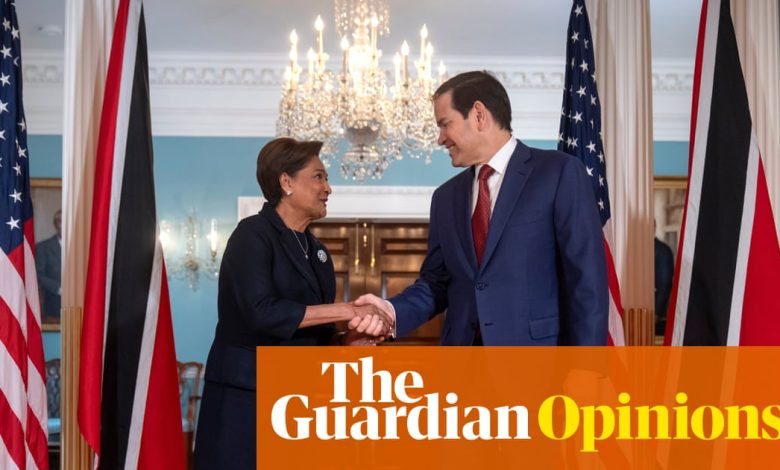
With Delcy Rodríguez now at the helm of Venezuela and Diosdado Cabello still a key player, the Maduro regime remains stable. Trinidad and Tobago now contends with a hostile neighbor, where its Prime Minister, Kamla Persad-Bissessar, has been branded a complicit enabler of U.S. aggression.
This situation did not materialize overnight. Through her administration’s rhetoric, Persad-Bissessar has gradually curtailed the nation’s diplomatic flexibility. The current crisis is the anticipated outcome of years of mismanagement masquerading as governance. Successive regimes have failed to establish a coherent foreign policy—an essential facet for any nation, especially one once deemed the wealthiest in the Caribbean.
For small states, the greatest error lies not in aligning with the “wrong” side, but in abandoning strategic ambiguity. Persad-Bissessar’s public alignment with the U.S. has boxed Trinidad and Tobago into a corner. Her disparaging comments toward respected Caribbean leaders and neglect of regional diplomacy have further isolated the nation at a time when geopolitical flexibility is crucial.
During her earlier term, Persad-Bissessar famously stated that Trinidad and Tobago was “not the ATM of the Caribbean,” signaling our reliance on regional solidarity was conditional. However, Caricom is not a marketplace; it is a supportive family. Disagreements should remain private, under a public façade of unity essential for the survival of small states.
The ramifications of her rhetoric are now coming to fruition. Following the events in Venezuela, the country faces isolation from a primary trading partner, with calls for regional boycotts emerging. Effective political strategy transcends mere toughness or simplistic ultimatums—a lesson this administration has neglected.
This narrative is not merely about choosing sides between Washington and Caracas; it reveals the vulnerabilities of small states that misinterpret alignment as a sustainable strategy.

Both Trump and Maduro operate through pressure and intimidation while personifying power and prioritizing loyalty over competence. Small states like Trinidad and Tobago cannot afford the luxury of moral clarity when caught in the crossfire between rival strongmen— the consequences are unavoidable.
Venezuela’s relationship with the Caribbean has historically been one of economic and strategic interdependence, notably through initiatives like PetroCaribe, where energy reliance has solidified both economic ties and political memories. The growing number of Venezuelan refugees in Trinidad and Tobago underscores this bond.
In the backdrop of increasing U.S. military presence in Trinidad, sold as counter-narcotics initiatives, the real intentions revolve around oil and resource control. The current U.S. administration’s framing of dissent as unpatriotic exacerbates the risks for smaller nations caught in the geopolitical crossfire.
Internally, Trinidad is divided and may soon be distracted by upcoming festivities. However, on the regional front, it risks remaining estranged. Perceptions of complicity in U.S. military actions against Venezuela will hinder economic relationships with the emerging Rodríguez-led government, risking losses exceeding $1.2 billion annually.
Should tensions escalate further, Trinidad could face the dire costs of economic collapse, an influx of refugees, and long-term instability—all while the U.S. shifts its focus to other global interests.