
Republicans can insult half the country without consequence. Democrats say “deplorables” once and never hear the end of it.
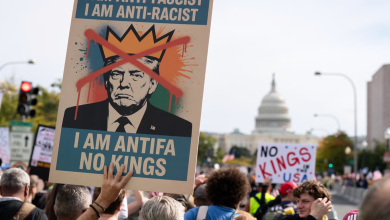
On Saturday, as millions of Americans gathered at more than 2,700 protests across all 50 states to demonstrate against what they see as President Donald Trump’s authoritarian overreach, the president had a response: He posted an AI-generated video of himself wearing a crown, flying a fighter jet labeled “King Trump,” and dumping feces on the protesters below.
I’m not being metaphorical here. The video, set to Kenny Loggins’s “Danger Zone” and styled after Top Gun, shows Trump in military gear bombing crowds of No Kings demonstrators in Times Square with streams of brown poop sludge. When asked about the video, a senior Trump administration official told Zeteo’s Swin Suebsaeng exactly what it depicts: “It is shit. A lot of it.”
The sitting president of the United States posted a video depicting himself defecating on millions of American citizens for the crime of protesting his administration. And the response from Republicans? Silence. From the media? Some articles (and many danced around the topic), but they didn’t exactly dominate the Sunday shows. House Speaker Mike Johnson went on ABC’s This Week and wasn’t asked a single question about it.
Compare that to what happens when a Democrat makes even the mildest critical observation about conservative voters. In 2008, Barack Obama tried to explain why economically struggling voters might “cling to guns or religion” as a way to make sense of their frustrations. He was trying to express empathy, to understand why his message wasn’t connecting. Nearly two decades later, conservatives still cite that comment as proof that Obama despised “real Americans.”
Or take Hillary Clinton’s “basket of deplorables” comment from 2016. Clinton was specifically trying to draw a distinction between Trump supporters generally and the white nationalists and conspiracy theorists who’d been energized by his campaign. She said you could put half of Trump’s supporters, who were “racist, sexist, homophobic, xenophobic, Islamophobic” in a “basket of deplorables.” Then she said the other half were “people who feel that the government has let them down” and deserve respect and understanding.
But that nuance didn’t matter. The entire Republican Party erupted in coordinated outrage. The comment became a defining moment of the campaign, cited endlessly as proof that Clinton had contempt for half the country. And the media amplified that narrative for weeks.
Here’s what almost never gets mentioned: Clinton was right about the first group. The Proud Boys, the Three Percenters, the neo-Nazis marching in Charlottesville, chanting “Jews will not replace us”—those people were absolutely part of Trump’s coalition, and anyone with any sense could and in fact should write them off as “deplorable.” Saying so wasn’t an insult to all Trump voters. It was an accurate observation about a specific faction. But Republicans acted as though she’d attacked every single person who’d ever considered voting for Trump, and the media let them get away with it.
Now look at what Trump does routinely. He doesn’t make careful distinctions between Democratic voters and extremists. He attacks entire cities, entire states, entire swaths of the country. And nobody freaks out.
Back in 2020, I wrote about this exact double standard for Media Matters. At the time, Trump had just called then-Representative Elijah Cummings’s Baltimore district “a disgusting, rat and rodent infested mess” where “no human being would want to live.” He’d said he “hated” New York. He’d called San Francisco a “decaying city.” He’d compared Chicago unfavorably to Afghanistan. He’d called Democrats “vicious, horrible people” who “want crime, they want chaos.”
And the media response was … muted. A few articles here and there. Maybe a mention in passing on cable news. Nothing sustained. Nothing that stuck to him the way “deplorables” stuck to Clinton or “cling to guns or religion” stuck to Obama.
These weren’t offhand remarks or private comments caught on tape. Trump was saying this stuff publicly, often at rallies, sometimes on Twitter. He was telling millions of Americans that their hometowns were hellholes, that they lived in crime-ridden wastelands, that their elected representatives were corrupt failures.
The pattern was obvious. Trump could say whatever he wanted about blue America, and it would be treated as normal campaign rhetoric. Meanwhile, any Democrat who acknowledged the reality that some conservative voters hold bigoted views, or tried to understand why economically struggling communities might be receptive to Trump’s message, would face weeks of manufactured outrage and media hand-wringing about “coastal elites” looking down on “real Americans.”
Five years later, nothing has changed. If anything, it’s gotten worse.
The reason for this asymmetry is simple: Republicans have figured out that they can weaponize victimhood. When Hillary Clinton said “deplorables,” the entire GOP apparatus sprang into action. Congressional Republicans gave speeches about it. Conservative media ran wall-to-wall coverage. Trump himself brought people Clinton had labeled “deplorable” to debates as props. The outrage was coordinated, sustained, and effective. The media amplified it because conflict drives coverage, and Republicans were providing plenty of conflict.
Democrats don’t do this. When Trump calls Baltimore “rat infested” or posts videos of himself defecating on protesters, there’s no coordinated response. A few members of Congress might tweet about it. Some Democratic voters express outrage online. But there’s no sustained campaign to make it a defining scandal. There are no prime-time speeches on the House floor. No carefully orchestrated media blitz.
And the media, with its long-standing bias toward treating Republican grievances as more legitimate than Democratic ones, follows the lead of whichever party is making the most noise. Republicans scream about “deplorables” for weeks, so it becomes a story. Democrats shrug at Trump’s latest attack on blue America, so it doesn’t.
The result is that Trump can post a video of himself as “King Trump” bombing American citizens with feces, and it barely registers. No demands for apologies. No wall-to-wall cable news coverage. No op-eds about presidential decorum or the need for unity. Just another day in an administration that has, from the start, treated roughly half the country with open contempt.