Trump Intensifies Call to Annex Greenland in Response to European Leaders | Davos

Trump’s Greenland Ambitions and the Impact on U.S.-Europe Relations
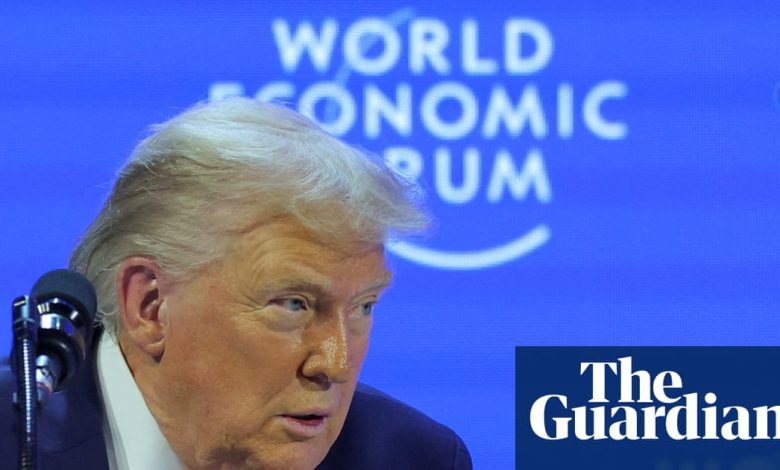
During a recent address at the World Economic Forum in Davos, President Donald Trump intensified his call for the annexation of Greenland, stating that the United States would not resort to military force to claim the territory. This speech, marked by contentious remarks directed at European political leaders, highlighted Trump’s ongoing political strategy to leverage economic and diplomatic power over allies.
Trump expressed, “I’m seeking immediate negotiations to once again discuss the acquisition of Greenland by the United States.” He further emphasized, “I don’t want to use force. I won’t use force. All the U.S. is asking for is a place called Greenland.” He suggested that cooperating with the U.S. could yield positive relations, while implying that refusal would have consequences.
The response from Denmark’s foreign minister, Lars Løkke Rasmussen, was measured. He welcomed Trump’s non-military approach but acknowledged that Trump’s ambitions for Greenland remained a complicated issue. “It is positive that military force will not be used, but that does not resolve the challenge,” Rasmussen noted.
Trump went on to critique historical decisions, calling it “stupid” for the U.S. to have ceded Greenland to Denmark after World War II. He framed the discussion around the strategic importance of Greenland in the context of global power dynamics, asserting that the U.S. must take “ownership” of the territory to effectively defend it against threats from Russia and China.
The president argued that Greenland’s geographic position is critical for national defense initiatives, including a proposed U.S. missile defense system dubbed “Golden Dome.” According to Trump, defending an ally’s territory requires ownership: “You can’t defend it on a lease. Who the hell wants to defend a license agreement, or a lease?”
Throughout the speech, Trump seemed to misspeak at times, confusing Greenland with Iceland and attributing fluctuations in stock markets to Icelandic actions. He attempted to present a robust defense of NATO while simultaneously criticizing its structure, claiming, “We give so much, and we get so little in return.”
European reactions varied significantly. Vula Tsetsi, co-chair of the European Green party, urged a united front against Trump’s rhetoric. Canadian Prime Minister Mark Carney urged smaller nations to resist U.S. “coercion,” emphasizing that “compliance with the United States will not buy safety.”
Internal dissent was evident even within Trump’s party. Senator Lisa Murkowski expressed concern over Trump’s portrayal of Greenland as mere “real estate,” highlighting the need to respect the indigenous communities living there. Governor Gavin Newsom of California dubbed the speech an “insignificant hour,” suggesting it contributed little to substantive international dialogue.
The president’s remarks also included claims of an economic upswing in the U.S. and a dismissal of the transition to clean energy technologies, labeling it the “new green scam.” Explaining his nationalistic stance, he attributed America’s current economic success to his administration, arguing against the backdrop of global challenges while boasting of his own heritage and criticizing immigration policies in Europe.
Trump also shared details regarding U.S. military operations involving regimes like Venezuela’s, which he claimed demonstrated American superiority over foreign threats. “Just two weeks ago, they saw weapons that nobody ever heard of. They weren’t able to fire one shot at us,” he asserted.